Noisy spaces, quiet consequences
- Mar 2
- 5 min read
For all the hype about dazzling offices and thoughtfully crafted spaces, one truth cuts through the noise: if unwanted sound isn’t controlled, everything else risks falling short.

Imagine walking through an open-plan office on a Wednesday morning, a long to-do list weighing on you and deadlines closing in. A product manager is presenting the latest strategy while a nearby stand-up bursts into laughter. A notification pings. Someone jumps on a call from their desk. None of it is intentional, and much of it fuels the energy of the office, yet without the right guardrails, all of it becomes disruptive.
The brain can’t help but tune in to a nearby conversation; it’s a hard-wired instinct. And in the hybrid era, that sensitivity has only heightened. After extended periods of homeworking, many employees simply refuse to sacrifice such a basic need as quiet, focused work when they return to the office.
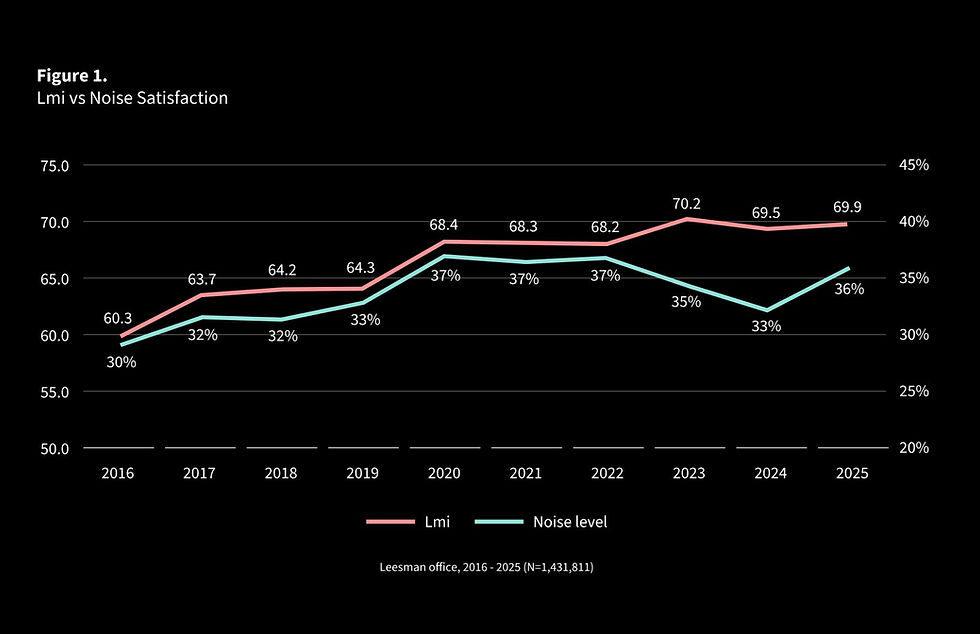
Leesman’s annual noise satisfaction scores point to a notable shift: for years, Lmi and noise satisfaction tracked closely together, until 2023, when noise satisfaction dropped to 35% and fell again to 33% in 2024, despite having reached 37% at the height of the pandemic.
But there’s a twist. Early indications from 2025 show the average score climbing again to 36%.
This points to two possible and not mutually exclusive realities: employees are learning to live with noise, or workplaces are finally getting better at managing it.
At the same time, the overall Leesman Lmi has continued to rise, suggesting steady progress in workplace performance more broadly. In other words, while offices are improving, noise remains a stubborn weak spot that still threatens to undermine the employee experience.
Nowadays, for many organisations, the workplace’s main purpose is to support collaboration, which is emphasised by shared spaces. But in doing so, and with employee expectations higher than ever, they risk overlooking the quiet truth: individual focus work still matters more than any other activity. In fact, 89% of employees say it’s an important workplace activity.*
And satisfaction with noise isn’t just about supporting individual tasks, although it is crucial. Every activity, from collaboration to individual work, needs a baseline of controlled noise to function well. When noise runs high, some people subconsciously tense their shoulders. Some reread the same paragraph. They push the hard task to later, then later again. By mid-afternoon, decision-making slows, tempers shorten, and the quality of work begins to fray.
“I’ll come in early tomorrow when it’s quiet” turns into a coping mechanism, not a culture.
Leesman data shows that ‘noise levels’ is important for 70% of employees, yet overall, only 35% are satisfied with it. It has long been one of the lowest-scoring workplace features, and this remains the case despite years of investment and workplace redesigns.
Even among Leesman+ workplaces, the ones certified as high-performing environments, satisfaction with noise levels sits at just 45% .** That’s 10 percentage points (pp) higher than the average office, yet still strikingly low for environments that excel in almost everything else. Few features expose the challenge of workplace design more clearly than noise: it is stubborn, pervasive, and remarkably difficult to “engineer out.”
Leesman Office data shows a clear contrast between people who are satisfied with noise levels and those who are not, across everything from activity support and feature satisfaction to measures of connection, wellbeing and pride in the workplace. For those dissatisfied with noise, office performance is consistently lower across the board.
The biggest gaps between these groups are found in physical features related to distraction and privacy: ‘Space between work settings’ (56 pp), ‘Movement of people past my workstation’ (55 pp), and ‘Dividers (between desks and work areas)’ (52 pp). This highlights how noise levels, privacy and a distraction-free environment are closely intertwined.
On performance, the gap is just as stark. Agreement with the workplace ‘enables me to work productively’ is 46 pp lower among those who are not satisfied with noise levels. That should be a major wake-up call for organisations. And there’s another signal they shouldn’t ignore: the 45 pp gap in agreement with ‘working here has a positive impact on my overall wellbeing.’
Unwanted noise isn’t just an irritation; it directly harms both perceived productivity and wellbeing. For organisations, this is a serious warning that poor noise management can undermine not just employee experience, but also performance in a big way.

Workplaces with poor noise control tend to perform poorly across many other dimensions too, suggesting that even for group activities like ‘informal social interaction’ (16 pp gap) or ‘learning from others’ (16 pp gap), some level of noise control still matters.
It’s also not always about other people being too loud either.
In very quiet kitchen spaces, people might feel awkward making noise themselves because they’re worried about disturbing colleagues. That’s why it’s important to create atmospheres where people can socialise or work together without feeling like they’re bothering anyone or being overheard.
What makes noise such a difficult issue to solve is that the answer isn’t purely physical. Satisfaction with noise levels is shaped not only by acoustics but also by behaviour, expectations, and personal preferences, from those who thrive in silence to those who prefer a soft background buzz, to others who find quiet unsettling. The same sound can soothe one person and irritate another.
A large part of the solution lies in pragmatic design supported by clear norms. Organisations need a variety of spaces for different types of work: lively collaboration zones, genuinely quiet libraries, and small rooms reserved for calls. Ceilings, floors, and partitions should be treated as performance assets, rather than decorative afterthoughts.
But even the best infrastructure needs etiquette to back it up. Guidelines should define where calls and meetings happen, and how teams protect focus hours. Yet the reality is messier: some people forget the policies; some interpret them loosely; others simply prefer to stay at their desk, whether for deep work or a “quick” call. And in those moments, one person’s convenience becomes an inconvenience for everyone else nearby.
So where is the line? It sits somewhere between personal autonomy and collective experience, a balance that only a thoughtful mix of design, culture, and leadership can sustain.
In the race to reinvent the office, one of the biggest competitive edges might be invisible: noise satisfaction.
In the end, noise is not a mere irritation, it’s a measurable drag on performance and wellbeing. Our research backs up what many employees already know instinctively: excessive noise weakens performance, affects perceived wellbeing, and gradually wears down satisfaction with the workplace. And while the modern office is evolving faster than ever, the fundamentals haven’t changed. People still need environments where they can think clearly, connect meaningfully, and work without constant interruption.
The path forward isn’t about eliminating noise entirely; offices are living, social spaces, but about designing and governing it with intent. That means combining high-performing acoustics, thoughtful architecture, and clear behavioural norms with leadership that reinforces them consistently. In a landscape where organisations are investing in employee workplace experience, mastering the invisible elements may be the biggest advantage of all.
Get noise wrong, and everything else becomes harder.
This article was written by Dr Sepideh Yekani of Leesman - the world's largest workplace experience database, and published in March 2026 here.


